

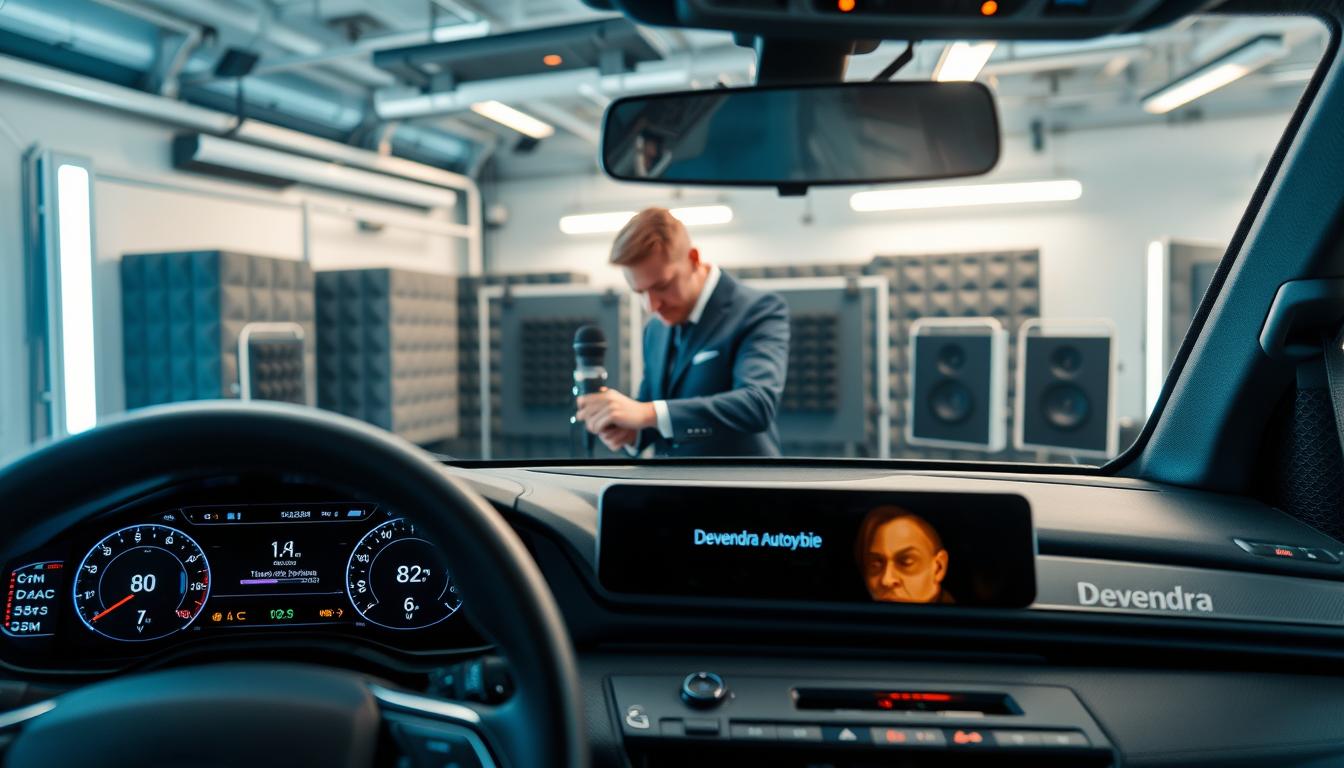
A quieter ride makes for a more comfortable drive. It’s key to improve automotive noise analysis for better comfort and satisfaction.
Less noise in the vehicle makes driving better. Good noise testing finds and fixes annoying sounds. This makes the ride more enjoyable.
Key Takeaways
- Optimizing automotive noise analysis enhances passenger comfort.
- Effective noise testing identifies sources of disturbance.
- A quieter ride improves overall driving satisfaction.
- Noise reduction is crucial for a comfortable driving experience.
- Manufacturers can mitigate unwanted sounds through thorough testing.
The Science Behind Vehicle Interior Noise
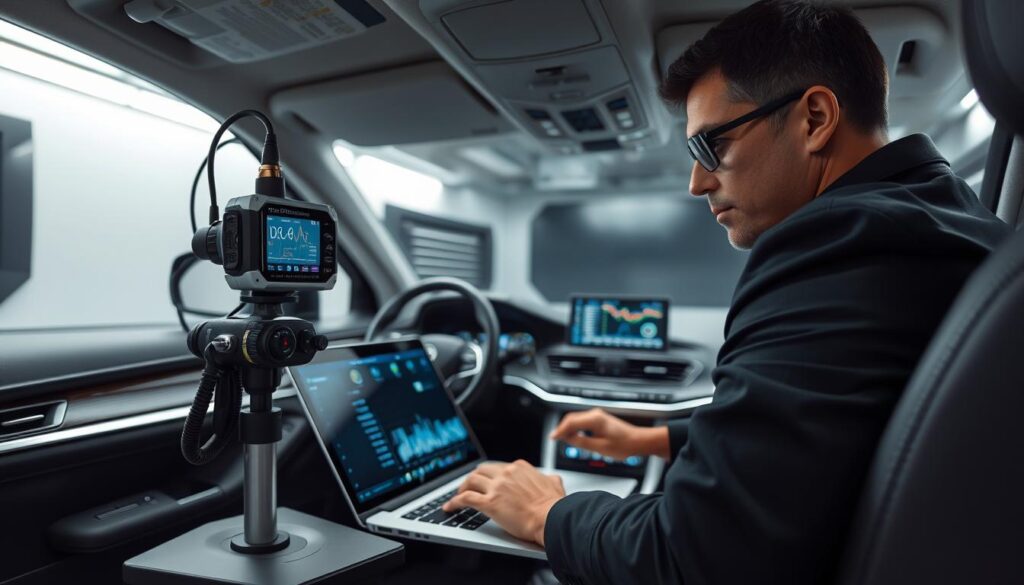
Understanding the science behind vehicle interior noise is key to a better driving experience. This noise is complex, influenced by the vehicle’s design, materials, and how it’s used.
Primary Noise Sources in Vehicles
The main sources of noise in vehicles are the engine, transmission, tires, and aerodynamics. The engine is a big contributor, making noise from combustion and mechanical parts. Tire noise gets louder at high speeds, depending on the tire and road.
Noise Transmission Paths
Noise travels from its source to the inside of the vehicle through different paths. These paths can be airborne, like through the body panels, or structure-borne, through the chassis and suspension. Knowing these paths helps in reducing noise effectively.
Impact on Driver and Passenger Experience
The quality of interior noise greatly affects driver and passenger comfort and safety. High noise levels can cause driver fatigue and distraction, which is dangerous. So, assessing the sound quality in cars is very important today.
Why Vehicle Interior Noise Testing Matters
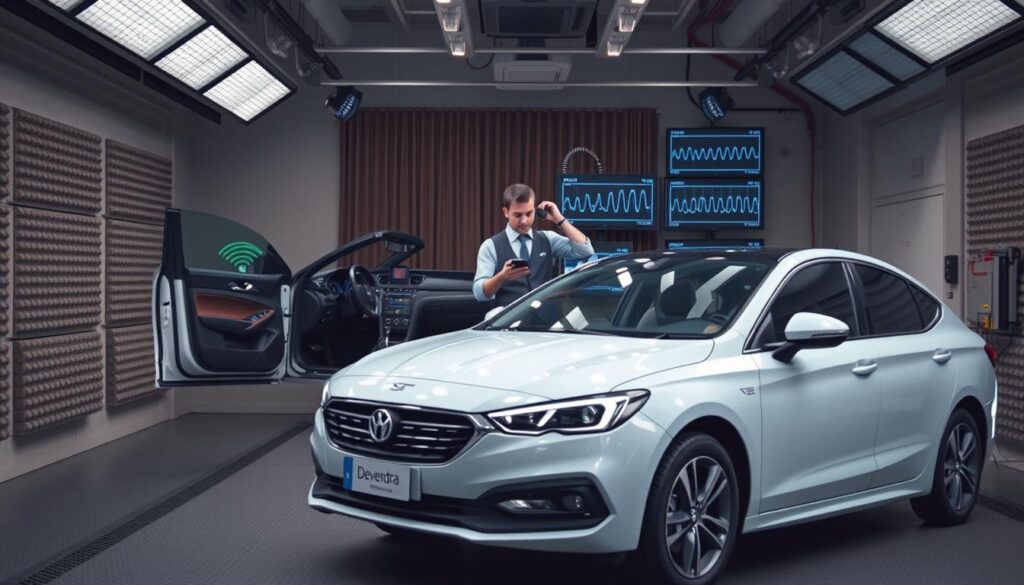
Testing the noise inside vehicles is key in the car world. It affects how happy customers are and how they see a brand. The quietness of a car’s interior greatly changes the driving experience. This makes it very important for car makers to focus on.
Customer Satisfaction and Brand Perception
A quieter car is seen as better quality and more luxurious. Using vehicle noise control solutions well can make drivers happier. This can also make people think more highly of a brand, as they link quiet rides with top-notch products.
Regulatory Requirements in India and Globally
Car makers must follow noise rules in India and worldwide. Doing car noise tests well is key to meeting these rules. Not following them can lead to big fines and harm a brand’s image.
Competitive Advantage in the Automotive Market
In a tough car market, good noise testing can give a big advantage. By making cars quieter, makers can stand out. This attracts people who want a quieter drive. The main benefits are:
- Happy customers
- Better brand image
- Following rules
- Unique products
By focusing on noise testing, car makers can get these benefits. This helps them stay ahead in the market.
Vehicle Interior Noise Testing Methodologies
Testing the noise inside a vehicle uses both numbers and people’s opinions. This way, we get a full picture of the sounds inside.
Stationary vs. Dynamic Testing Approaches
There are two main ways to test vehicle noise. Stationary testing checks noise when the car is still, with the engine on. Dynamic testing looks at noise when the car is moving.
Dynamic testing is more like real driving. It shows how different driving situations affect the noise inside.
Objective Measurement Techniques
Tools like sound level meters and microphones measure noise levels. These tools help find out where the noise comes from and if it’s being reduced well.
Subjective Evaluation Methods
People’s opinions on the noise inside a car are also important. This includes jury tests and scales that ask how people feel about the noise.
Jury Testing Protocols
A group of people listen to the car’s noise and share their thoughts. Their opinions help us understand how the noise feels to others.
Semantic Differential Scales
These scales ask people to rate the noise. For example, “pleasant” or “loud”. This helps us understand how people feel about the noise.
By mixing numbers and people’s feelings, car makers can really understand the noise inside. This makes driving better for everyone.
Essential Equipment for Acoustic Measurement
High-quality acoustic measurement equipment is key for successful vehicle interior noise testing. It’s important to know the different tools and technologies available.
Microphone Types and Specifications
The right microphone is crucial for accurate sound data capture. Free-field microphones are best for outdoor sound measurements. On the other hand, pressure microphones work better inside vehicles.
Data Acquisition Systems
Data acquisition systems are vital for collecting and processing sound data. They should handle multiple channels and have high sampling rates for accurate data capture.
Acoustic Cameras and Sound Visualization Tools
Acoustic cameras and sound visualization tools help find noise sources in vehicles. They show sound data visually, making analysis and pinpointing easier.
Calibration Requirements and Procedures
Calibration is key to ensure accurate data from acoustic measurement equipment. Regular checks keep the data reliable during vehicle interior noise testing.
Setting Up Vehicle Interior Noise Testing Facilities
The setup of vehicle interior noise testing facilities is key in the automotive world. It lets makers check and better vehicle sounds.
Anechoic and Semi-Anechoic Chambers
Anechoic and semi-anechoic chambers are vital for precise vehicle noise tests. Anechoic chambers soak up all sound, while semi-anechoic ones have a reflective floor. This mimics real driving.
- Anechoic chambers are perfect for exact sound checks.
- Semi-anechoic chambers strike a balance between precision and cost.
Chassis Dynamometer Testing Environments
Chassis dynamometer setups mimic different driving scenarios. They’re great for detailed vehicle noise tests.
Key benefits include:
- Controlled test settings.
- Consistent test outcomes.
- Lower costs than testing on the road.
On-Road Testing Considerations
On-road tests are crucial for checking lab results against real-world noise levels.
- Needs careful planning and execution.
- Must consider factors like road type and weather.
Cost-Effective Facility Solutions for Indian Manufacturers
Indian makers can save money by:
- Choosing semi-anechoic chambers over fully anechoic ones.
- Using shared testing spaces or teaming up with research groups.
- Investing in modular, expandable test setups.
Understanding the options for setting up noise testing facilities helps makers. They can make smart choices that fit their budget, need for accuracy, and follow rules.
Standards and Protocols for Vehicle Interior Noise Testing
The car industry uses many standards and protocols to check and improve the quietness inside cars. These rules help keep quality high and meet legal needs. They also make customers happier.
International Standards (ISO, SAE)
International standards are key for testing car interior noise. Groups like the International Organization for Standardization (ISO) and the Society of Automotive Engineers (SAE) set rules followed worldwide. For example, ISO 362-1:2015 outlines how to measure the noise of cars speeding up, which is important for checking the quietness inside.
Indian Automotive Industry Standards
In India, car makers follow rules set by the Automotive Research Association of India (ARAI) and others. These rules help Indian cars compete globally by meeting both local and international standards.
OEM-Specific Test Requirements
Car makers often have their own test rules that go beyond or add to international and national ones. These rules are made for each car maker and their models. They focus on sound quality and how comfortable it is inside the car.
Documentation and Reporting Guidelines
It’s very important to document and report car interior noise tests well. Test reports should have all the details of the test, the tools used, and the results. This makes it clear and easy to compare tests from different cars and places.
| Standard/Protocol | Description | Applicability |
|---|---|---|
| ISO 362-1:2015 | Measurement method for noise emitted by accelerating road vehicles | Global |
| SAE J2889-1 | Measurement of vehicle interior sound | Global, widely adopted |
| ARAI Standards | Guidelines for automotive noise testing in India | India |
By following these standards and rules, the car industry makes sure tests are done right and consistently. This leads to better comfort in cars and happier customers.
Advanced Analysis Techniques for NVH Data
In the quest for improved vehicle interior noise comfort, advanced analysis techniques for NVH data are key. These methods help automotive engineers understand how noise sources, transmission paths, and sound perception interact.
Frequency Domain Analysis Methods
Frequency domain analysis is a powerful tool for identifying and characterizing the various noise components within a vehicle. It transforms time-domain signals into the frequency domain using techniques like Fast Fourier Transform (FFT). This way, engineers can isolate specific frequency ranges associated with different noise sources.
Time-Frequency Analysis Approaches
While frequency domain analysis provides valuable insights, time-frequency analysis approaches offer a more nuanced understanding of non-stationary signals. Techniques such as Short-Time Fourier Transform (STFT) and Wavelet Transform allow for the examination of how frequency content evolves over time. This is crucial for understanding transient noises.
Psychoacoustic Metrics for Human Perception
Understanding how humans perceive noise is critical for effective NVH analysis. Psychoacoustic metrics, such as loudness, sharpness, and roughness, provide a more accurate representation of how noise is perceived by occupants. These metrics help in designing vehicles that are not only quieter but also more comfortable.
Statistical Energy Analysis Applications
Statistical Energy Analysis (SEA) is a method used to predict and analyze the vibro-acoustic behavior of complex systems like vehicles. By dividing the system into subsystems and analyzing energy flow, SEA helps in identifying critical paths for noise transmission. It optimizes vehicle design for better NVH performance.
| Analysis Technique | Application | Benefits |
|---|---|---|
| Frequency Domain Analysis | Identifying noise sources | Isolates specific frequency ranges |
| Time-Frequency Analysis | Analyzing non-stationary signals | Provides time-varying frequency content |
| Psychoacoustic Metrics | Understanding human perception | More accurate representation of perceived noise |
| Statistical Energy Analysis | Predicting vibro-acoustic behavior | Identifies critical noise transmission paths |
Optimizing Vehicle Interior Noise Testing Procedures
To get reliable data, vehicle interior noise testing needs careful planning. This is key for accurate results that help improve vehicle design and customer happiness.
Test Planning and Preparation Best Practices
Good test planning starts with knowing what noise to measure. This includes engine, road, and wind noise. It’s also important to set up test conditions like speed, road type, and weather.
Data Collection and Management Strategies
Collecting data should be done in a methodical way. Use the right tools and software to record and analyze noise. A good system for managing data is crucial for keeping it organized and accessible for later use.
Ensuring Repeatability and Reproducibility
For reliable test results, keep test conditions and steps the same. Regularly check your equipment and train your team to reduce any differences in results.
Streamlining Testing for Production Environments
To make testing fit into production without delays, integrate it smoothly into the manufacturing process. Use efficient test methods and the latest technology to do this.
| Optimization Technique | Description | Benefit |
|---|---|---|
| Test Planning | Define test conditions and parameters | Improved test accuracy |
| Data Management | Systematic data collection and storage | Enhanced data reliability |
| Repeatability Measures | Consistency in test conditions and equipment calibration | Increased test reliability |
Noise Reduction Strategies Based on Test Results
Vehicle interior noise testing gives us important insights. It helps us find the best ways to make cars quieter. By looking at the test data, makers can see what works best.
Material Selection for Sound Absorption
Choosing the right materials is key to quieter cars. These materials go into the dashboard, doors, and floor. They help soak up sound.
- Acoustic foams
- Sound-absorbing fabrics
- Insulating materials
Structural Modifications for Vibration Control
Changing the car’s structure helps control vibrations. This is important because vibrations make noise. By tweaking the structure, makers can stop vibrations from spreading.
| Modification | Effect on Noise Reduction |
|---|---|
| Adding damping materials | Reduces vibration-induced noise |
| Optimizing structural design | Minimizes noise transmission paths |
Active Noise Cancellation Technologies
Active noise cancellation is a new way to quiet cars. It works by making sound waves that cancel out unwanted noise.
Cost-Effective Solutions for the Indian Market
In the Indian market, keeping costs down is important. Makers can save money by improving designs and using local materials.
By using these strategies, car makers can make driving better for everyone.
Case Studies: Successful Noise Optimization in Indian Vehicles
Many Indian car makers have made big strides in cutting down on noise inside their cars. This has made driving a lot better. We’ll look at some of these successes across different types of vehicles.
Luxury Vehicle Segment Achievements
Mercedes-Benz and BMW have used new ways to make their luxury cars quieter in India. For example, they’ve used acoustic laminated glass to cut down on noise inside the car.
Commercial Vehicle Cabin Improvements
Tata Motors has greatly improved the quietness of their commercial vehicles’ cabins. They’ve done this by tweaking engine mounts and adding sound-absorbing materials.
Electric Vehicle Noise Challenges and Solutions
Electric cars face a special problem because they don’t make engine noise. But, Mahindra Electric is finding ways to make EVs sound better while driving.
Small Car Segment Noise Optimization
Maruti Suzuki has found ways to make their small cars quieter without spending a lot. They’ve used sound-absorbing materials and smart car design.
Future Trends in Automotive Acoustic Testing
The future of car sound testing is changing fast. New methods are becoming key. They help make cars quieter and more comfortable.
Artificial Intelligence in Noise Analysis
Artificial intelligence (AI) is now used in car sound testing. It makes the tests more detailed and accurate. This helps find and fix sound issues better.
Virtual Testing and Simulation Advancements
Virtual testing and simulation are getting more common. They let makers test and fix sound problems early. This saves time and money.
| Technology | Application in Acoustic Testing | Benefits |
|---|---|---|
| Artificial Intelligence | Noise pattern analysis and prediction | Improved accuracy and efficiency |
| Virtual Testing | Simulation of real-world driving conditions | Reduced costs and faster development cycles |
Electric and Autonomous Vehicle Considerations
Electric and self-driving cars bring new sound challenges. They sound different from gas cars. This means sound testing needs to change too.
Emerging Technologies for Enhanced Measurement
New tech like advanced microphones and sound cameras is improving sound tests. They help find and fix sound problems better.
These trends will change car sound testing a lot. They will help make cars quieter and more comfy. This will meet what people want in their cars.
Conclusion
Improving vehicle interior noise testing is key to a better driving experience. Understanding the science behind vehicle noise helps manufacturers enhance sound quality. This leads to happier customers and a stronger brand image.
In the competitive Indian market, controlling vehicle noise is crucial. Advanced analysis and noise reduction strategies help meet and exceed customer expectations. This is vital for success in the automotive industry.
The future of testing vehicle noise looks bright with new technologies. Artificial intelligence, virtual testing, and simulation will play big roles. These advancements will help the industry grow and stay competitive.
About Devendra Automobile :
At Devendra Automobile Pvt. Ltd., headquartered in Kothrud, Pune, Maharashtra, India, we are a leading automotive compliance and consulting services provider offering expert solutions such as vehicle interior noise testing, CMVR certification, type approval support, homologation consultancy, and regulatory compliance guidance for manufacturers, OEMs, and automotive suppliers across India. With years of experience in helping vehicles meet national and international standards, we ensure accurate noise testing to enhance comfort, meet quality benchmarks, and support legal compliance for passenger and commercial vehicles. Our services cater to clients not only in Pune and Pimpri-Chinchwad (PCMC), but also across major automotive and industrial regions including Mumbai, Bengaluru, Chennai, Delhi-NCR, Hyderabad, Ahmedabad, Jaipur, Kolkata, Gurgaon, and Nagpur — ensuring reliable vehicle testing, documentation support, and regulatory certification throughout India.
 Previous Post
 Next Post