
India’s regulatory rules are a key step for manufacturers who want safe, compliant equipment. Obtaining ais-112 certification is mandatory for agricultural trailer makers and helps each unit meet national safety standards. This process is more than one inspection; it guides the product through its entire lifecycle.
Our guide covers the main stages of agricultural trailer certification, including design specifications, technical documents, and production conformity. It also explains agricultural trailer testing, which supports the type approval process. Learning these technical requirements early can help manufacturers reach the market faster.
Success depends on matching your design and technical files before formal evaluation begins. Following the ais-112 guidelines helps avoid costly delays and prepares equipment for India’s demanding agricultural sector.
Key Takeaways
- AIS-112 is a mandatory safety standard for agricultural trailers in India.
- The certification process includes design review, testing, and production conformity.
- Proper documentation is essential for a smooth type approval experience.
- Testing is a multi-stage process rather than a single, isolated inspection.
- Early preparation of technical files significantly reduces the risk of project delays.
AIS-112 Scope and Its Role in Agricultural Trailer Type Approval in India
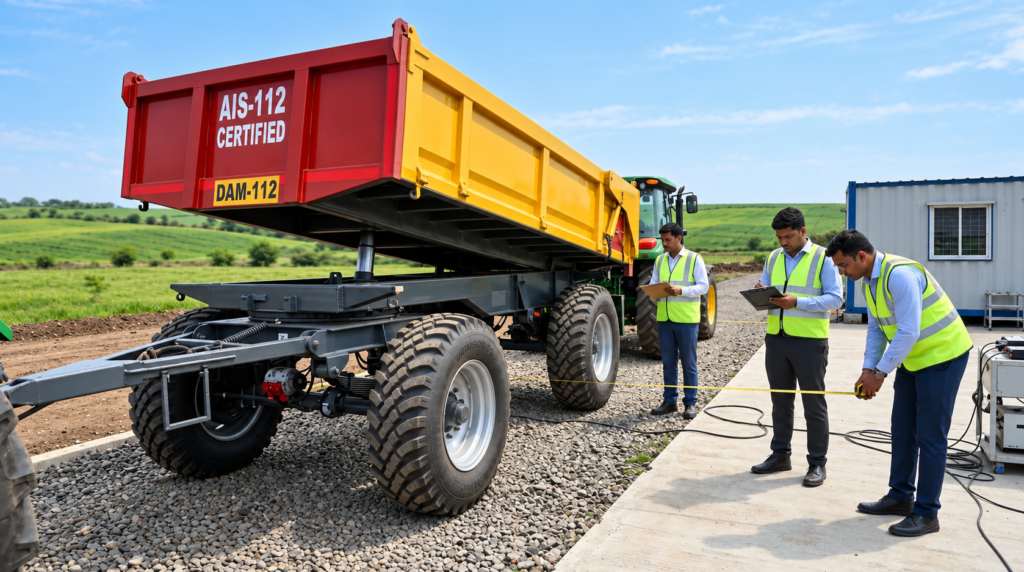
Understanding trailer type approval india starts with the ais-112 guidelines. This standard sets safety and performance rules for agricultural equipment before it enters public roads.
What AIS-112 Covers for Agricultural Trailers
Trailer categories, intended uses, and vehicle configurations
This standard covers agricultural trailer designs, from simple tipping trailers to complex multi-axle configurations. It sets categories by gross vehicle weight and intended agricultural use. Proper classification is vital because each trailer must safely support its rated load.
How AIS-112 relates to Indian automotive compliance
AIS-112 connects engineering practices with mandatory Indian automotive compliance. It requires every trailer made in India to follow standard safety rules. These rules support safer rural and agricultural transport.
When Manufacturers Need Agricultural Trailer Certification
New trailer designs and type approval applications
Any entity introducing a new trailer model must complete formal certification. This process checks the design against safety rules before mass production begins. Approval is required for legal road use in India.
Design changes, variants, and possible reassessment requirements
Changes to an existing design may require further evaluation. Major changes to the chassis, brakes, or suspension typically require reassessment. Maintaining compliance requires accurate records for each variant.
Regulatory Authorities and Approved Testing Agencies
Responsibilities of the manufacturer and certification authority
Manufacturers must provide accurate technical data and representative test vehicles. The certification authority reviews the submission and checks each standard. This process helps safe, compliant trailers reach the market.
Importance of confirming the current AIS-112 edition and applicable rules
Before applying, verify the latest version of the standard. Rules change, and outdated guidance can cause costly delays. Confirm the specific ais-112 certification requirements with the testing agency before submitting current documents.
| Process Stage | Key Responsibility | Outcome |
|---|---|---|
| Initial Application | Manufacturer | Submission of technical files |
| Compliance Review | Testing Agency | Verification of design data |
| Final Certification | Authority | Issuance of approval |
- Verify the latest AIS-112 edition.
- Ensure all technical drawings are updated.
- Coordinate with an approved testing agency early.
AIS-112 Certification Requirements for Agricultural Trailer Design
Designing agricultural trailers to meet ais-112 standards requires strong knowledge of structural and safety engineering. Manufacturers must match every part, from the chassis to the lighting system, with India’s road-use rules.
Structural and Dimensional Requirements
Frame strength, chassis construction, and load-bearing components
The chassis must withstand heavy agricultural loads. Engineers should choose high-tensile steel to resist fatigue and bending during hard field use.
Overall dimensions, ground clearance, axle arrangement, and turning clearance
Trailers must follow strict size limits to protect road safety. Proper ground clearance helps them cross uneven ground without raising the center of gravity.
Drawbar, coupling, towing eye, and attachment-point requirements
The drawbar connects the tractor and trailer. It must withstand strong forces during acceleration and braking.
Axles, Wheels, Tires, and Suspension
Rated axle capacity and load distribution
Axles must support the manufacturer’s maximum gross vehicle weight. Even load distribution reduces wear and improves stable handling.
Tire specifications, wheel compatibility, and inflation considerations
Select tires by their load ratings and the agricultural terrain they will cross. The wheel rim and tire bead must fit properly to prevent blowouts under heavy loads.
Suspension performance and durability expectations
A strong suspension absorbs shocks and protects the trailer frame and towing tractor. Durability testing is central to agricultural trailer testing, helping confirm long-term performance in harsh conditions.
Braking, Parking, and Stability Provisions
Service braking and parking-brake requirements
Every trailer needs reliable service brakes for road travel. A secure parking brake must prevent movement when the trailer is detached.
Braking compatibility with the towing tractor
The trailer brakes must work smoothly with the tractor’s hydraulic or pneumatic controls. This keeps the trailer from pushing or pulling the tractor during emergency stops.
Rollover resistance, stability, and safe operation on agricultural terrain
Stability matters on slopes and uneven fields. Manufacturers must test whether the ais-112 design limits the risk of rollover.
| Feature | Requirement | Safety Impact |
|---|---|---|
| Braking System | Synchronized Response | Prevents Jackknifing |
| Parking Brake | Mechanical Lock | Prevents Runaway |
| Stability | Low Center of Gravity | Reduces Rollover Risk |
Lighting, Marking, and Safety Equipment
Lighting and signaling equipment required for road operation
Visibility is essential for road safety. Trailers need working tail lamps, turn signals, and brake lights that meet national standards.
Reflective markings, identification plates, and warning labels
Reflective tape and clear identification plates help drivers see the trailer at night. Place warning labels near moving parts to alert operators about hazards.
Guards, mudguards, projections, and operator-safety features
Safety guards must cover rotating parts and prevent accidental contact. Mudguards limit debris spray and protect vehicles that follow.
- Ensure all electrical connections are waterproof.
- Verify that all sharp projections are shielded.
- Confirm that warning labels are weather-resistant.
Documentation and Pre-Test Preparation for AIS-112 Certification
Success in obtaining trailer type approval in India depends on a complete technical file. The file helps the testing agency check your design against AIS-112 without delays.
Technical Documents to Assemble
General arrangement drawings and detailed component drawings
Provide clear engineering drawings that show the trailer’s design. Include assembly views and details for critical safety components.
Specifications for materials, axles, brakes, tires, couplings, and lighting
Provide technical specifications for every major sub-assembly. Clearly record material grades and performance ratings to prove safety compliance.
Rated capacities, mass calculations, and load-distribution data
Calculate the gross vehicle weight and axle-load distribution accurately. These figures show the trailer stays stable and safe at maximum load.
Manufacturer Information and Compliance Records
Company details, manufacturing location, and production-control information
The certification body needs complete information about your manufacturing facility. Provide records of production controls that support consistent quality.
Supplier certificates and test reports for critical components
Keep valid test reports for parts from third-party suppliers. This evidence supports agricultural trailer certification and shows that components meet safety standards.
Design-change records and traceability procedures
Keep a clear record of every design change. Strong traceability ensures each trailer matches the certified design.
Preparing the Representative Test Trailer
Choosing a production-representative configuration
Submit a standard production model for testing. A prototype that differs from final production may cause failed tests or invalid results.
Checking dimensions, component markings, and equipment before submission
Inspect the trailer carefully before sending it to the test site. Check that dimensions match the drawings and safety markings are visible.
Addressing prototype deviations before formal testing
Fix any differences between the trailer and design specifications at once. Early changes prevent costly retesting during the AIS-112 process.
Pre-Submission Compliance Review
Creating a clause-by-clause AIS-112 compliance matrix
A compliance matrix helps track your progress. It links every AIS-112 requirement to test evidence and reveals missing information.
Identifying missing evidence, nonconforming parts, and measurement risks
Use the matrix to find possible problems early. Finding nonconforming parts before agricultural trailer certification saves time and resources.
Coordinating the manufacturer, test agency, and technical team
Clear communication between your team and the testing agency is essential. Regular coordination clarifies the test scope and documentation needed for successful trailer type approval in India.
Agricultural Trailer Testing Process Under AIS-112
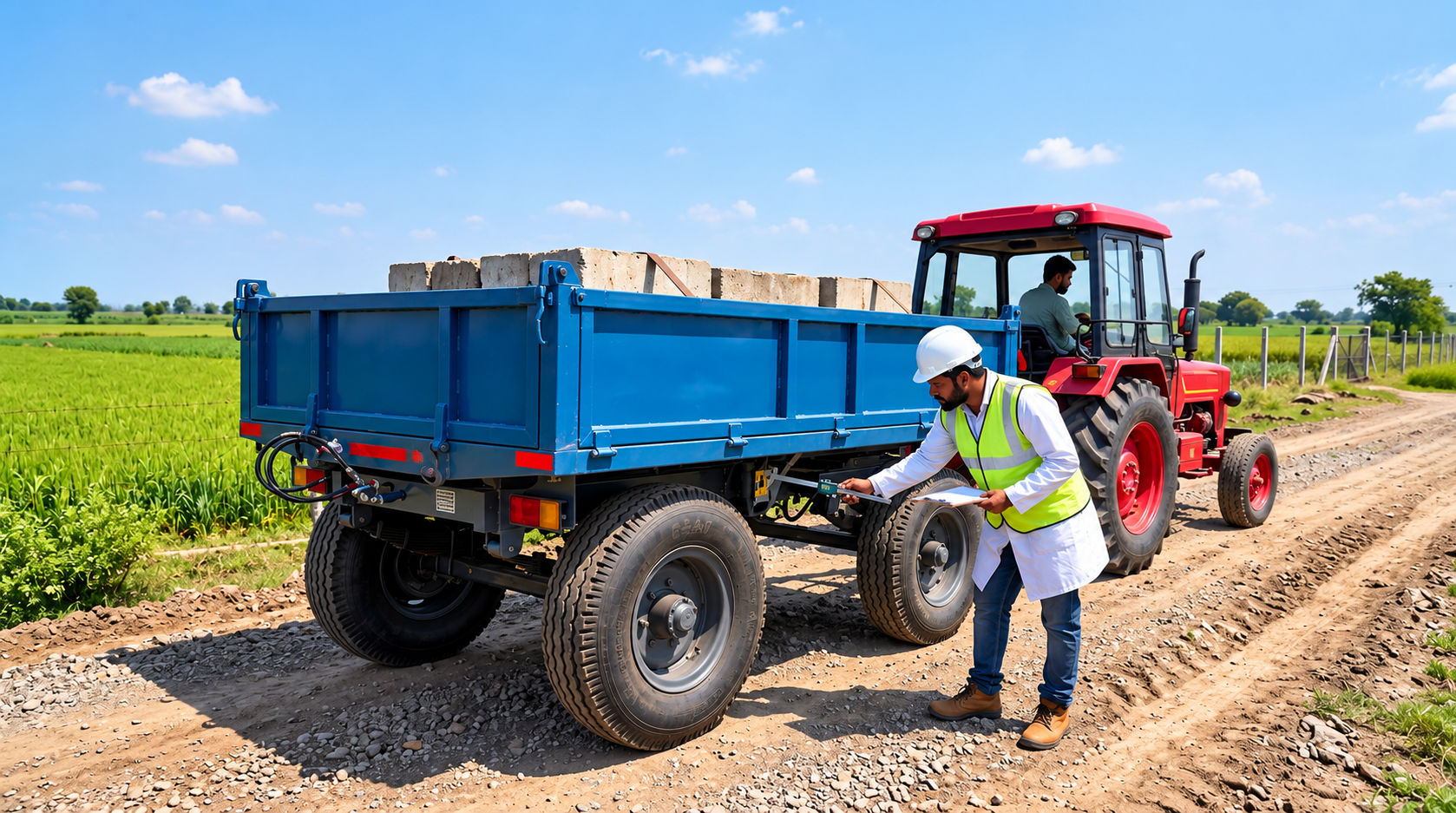
Agricultural trailer testing follows a structured sequence for regulatory compliance. It checks each unit against government safety and performance standards.
Application and Test-Plan Confirmation
Submitting the application and technical documentation
Manufacturers first submit a formal application and detailed technical documents. These include engineering drawings, material specifications, and design calculations required for ais-112 certification requirements.
Confirming the test scope, samples, instrumentation, and acceptance criteria
After receiving the application, the testing agency reviews its scope. Engineers confirm test samples, instruments, and acceptance criteria, keeping agricultural trailer testing objective and clear.
Scheduling inspections and laboratory or proving-ground activities
After finalizing the plan, the agency schedules inspections and performance tests. These may occur at a certified laboratory or designated proving ground.
Initial Inspection and Dimensional Verification
Physical inspection against approved drawings
Inspectors compare the trailer with its submitted design drawings. They verify that the manufactured unit matches every approved specification.
Verification of dimensions, mass, axle loads, and ground clearance
Technicians measure the trailer against required dimensional limits. They also check unladen mass, axle loads, and ground clearance for Indian roads.
Inspection of coupling devices, safety equipment, markings, and workmanship
Inspectors evaluate coupling devices and safety equipment placement. They also check markings and build quality against AIS-112 standards.
Brake and Performance Testing
Service-brake effectiveness and stopping-performance checks
Braking performance is a key part of the evaluation. Testers measure service-brake effectiveness while towing the trailer at maximum load.
Parking-brake holding performance and control operation
Testers confirm that the parking brake holds the trailer on specified gradients. They also check that operators can engage its controls easily.
Testing with the intended towing vehicle or approved test arrangement
Testers use the intended towing vehicle or a standardized test rig. This confirms stable interaction between the tractor and trailer.
Structural, Load, and Durability Testing
Static-load and stress assessment of the chassis and body
Engineers assess static loads to evaluate chassis strength. They study stress points to ensure the trailer carries heavy agricultural loads safely.
Drawbar, coupling, axle, and attachment-point testing
Engineers stress-test the drawbar and coupling points to prevent detachment. They also inspect axles and attachment points for field-work forces.
Durability or endurance testing under representative agricultural conditions
Trailers undergo endurance tests that copy harsh agricultural conditions. These tests reveal design weaknesses before the product reaches the market.
Safety and Road-Use Verification
Lighting, signaling, reflectors, and conspicuity checks
Road safety depends on visibility. Inspectors check that lighting, signals, and reflectors work correctly and meet AIS-112 visibility requirements.
Assessment of projections, guarding, access, and operator safety
Inspectors check for dangerous projections and guards on moving parts. They also assess access points to protect operators during daily use.
Stability and maneuverability evaluation where applicable
When required, testers assess stability and maneuverability. These tests confirm correct tracking behind the towing vehicle during turns and high-speed maneuvers.
Handling Nonconformities and Retesting
Recording test failures and identifying the root cause
If a trailer fails, the agency records the specific nonconformity. The manufacturer then analyzes its root cause and identifies the failure.
Implementing corrective design or manufacturing changes
After finding the cause, the manufacturer makes needed design or manufacturing changes. The manufacturer documents these changes and submits them for review.
Determining when partial or complete retesting is necessary
The testing agency decides whether changes require full or partial retesting. This confirms compliance with all ais-112 certification requirements before approval.
| Testing Phase | Primary Focus | Key Objective |
|---|---|---|
| Initial Inspection | Dimensions & Build | Verify design compliance |
| Brake Testing | Stopping Power | Ensure road safety |
| Structural Assessment | Chassis & Drawbar | Confirm load capacity |
| Safety Verification | Lighting & Guards | Protect operators |
Type Approval, Certification, and Production Compliance
Moving from prototype testing to mass production requires strict compliance with regulatory rules. After testing, formal validation and ongoing quality checks support long-term safety.
Review of Test Results and Compliance Evidence
How the testing agency evaluates results against AIS-112
Testing agencies compare performance data with the requirements in ais-112. They check that every measurement, including braking distance and structural integrity, stays within allowed limits.
Resolving technical observations and closing documentation gaps
If the agency finds technical issues, manufacturers must provide corrective evidence or design changes. Closing these documentation gaps helps complete the agricultural trailer certification process without delays.
Maintaining consistency between the tested unit and intended production units
The tested unit must represent the final product accurately. Manufacturers must document differences between the prototype and assembly-line units, protecting the test results’ validity.
Issuance of the Agricultural Trailer Type Approval
Certification records, approved specifications, and identification details
After a successful review, the agency issues the agricultural trailer type approval. This document lists chassis numbers and approved specifications that define the trailer’s legal configuration.
Conditions attached to the approval and permitted configurations
Approval often includes conditions for use, load limits, and towing compatibility. Manufacturers must follow these permitted configurations to keep their certification status.
Using certification evidence for registration and commercial deployment
Regional transport authorities require this official evidence for vehicle registration. It proves that the trailer is safe for commercial use on public roads.
Production Conformity and Quality Controls
Controlling dimensions, materials, welds, and critical components
Maintaining production conformity requires close oversight of manufacturing. Quality teams must check material consistency, weld strength, and accurate structural dimensions.
Incoming inspection and supplier-change management
Manufacturers must inspect all incoming raw materials and parts. They must assess supplier changes for critical components to protect the original certification.
End-of-line checks for brakes, lights, tires, couplings, and markings
Every trailer needs a final inspection before leaving the factory. Inspectors check brakes, lighting systems, tire pressure, and required safety markings.
| Control Area | Primary Focus | Verification Method |
|---|---|---|
| Structural Integrity | Weld quality and steel grade | Visual and ultrasonic testing |
| Braking System | Pressure and response time | Pressure gauge calibration |
| Safety Markings | Visibility and placement | Standardized template check |
| Component Sourcing | Supplier consistency | Batch record auditing |
Managing Design Changes After Certification
Changes that may require notification or approval
Major design changes after certification may require formal notice. This lets regulators assess whether the change affects the trailer’s safety.
Impact of revised axles, tires, brakes, body structures, or towing systems
Replacing axles, tires, or brakes can change the vehicle’s handling. These revisions often require reevaluation to confirm the trailer still meets safety standards.
Keeping technical files and certification records current
Keeping the technical file current is legally required for ongoing compliance. Accurate records show that production remains aligned with the original agricultural trailer certification standards.
Practical Compliance Strategy for Manufacturers
Compliance for agricultural trailers requires planning before manufacturers build the first prototype. Adding rules early helps manufacturers avoid costly delays and enter the market more smoothly.
Build Compliance Into the Design Stage
Using AIS-112 requirements in engineering specifications
Engineers should add AIS-112 standards to early CAD models and technical drawings. This step helps every component, from the chassis frame to the lighting system, meet required safety limits.
Designing for manufacturability, inspection access, and serviceability
Design teams should give inspectors easy access during certification. Clear access to brake systems and structural welds makes checks easier and shortens physical inspections.
Preventing late-stage changes that trigger additional testing
Late design changes often require costly retesting. Finalizing specifications early helps manufacturers stay consistent and avoid extra documents or repeated laboratory visits.
Control Costs, Timelines, and Testing Risks
Planning prototypes, test samples, and laboratory resources
Good project management schedules laboratory time well ahead. Early test slots prevent bottlenecks and keep the agricultural trailer certification timeline on track.
Prioritizing safety-critical components for early validation
Testing braking, lighting, and structural integrity early can reveal failures before they grow. Fixing these safety-critical parts first lowers overall trailer testing risks.
Budgeting for corrective actions and possible retesting
A realistic budget should include a contingency fund for unexpected modifications. This buffer keeps the project viable when minor adjustments are needed to meet specific compliance criteria.
| Compliance Phase | Primary Focus | Risk Level |
|---|---|---|
| Design Stage | Engineering Specs | Low |
| Prototype Build | Safety Validation | Medium |
| Final Testing | Regulatory Audit | High |
Use a Complete Certification File
Organizing drawings, calculations, reports, photographs, and approvals
A central certification file helps demonstrate compliance during audits. Keeping technical data, including stress calculations and material certifications, together makes reviews faster.
Maintaining revision control and component traceability
Strong version control shows which design iteration is being tested. Clear component source records provide traceability and support long-term quality assurance.
Preparing evidence for audits, inspections, and future variants
Well-documented files support future product variants. A complete approval history helps manufacturers adapt designs for new markets without starting over.
Verify Requirements Before Submission
Checking the latest applicable AIS-112 provisions
Because standards change, verify that the design follows the latest AIS-112 provisions. Regular updates to the internal compliance manual help prevent outdated technical requirements.
Confirming agency-specific submission procedures and test conditions
Each testing agency may use different submission procedures. Confirming these requirements early prevents administrative errors that could delay final type approval.
Obtaining specialist review for complex trailer configurations
For non-standard or complex trailer designs, expert review is a smart certification compliance strategy. Professional consultants can find problems that might cause serious trailer testing risks during formal evaluation.
Conclusion
Achieving regulatory success requires discipline at every manufacturing stage. The path to ais-112 certification requires careful checks of structural integrity, braking performance, and safety lighting systems. Manufacturers who apply these technical standards during initial design often face fewer obstacles during official evaluations.
A strong technical file remains vital for consistent production quality. Clear documentation ensures every unit leaving the factory matches specifications verified during testing. This practice protects your brand reputation and simplifies future design updates or modifications.
Securing trailer type approval india requires early contact with approved testing agencies and knowledge of current safety mandates. By checking every requirement before submission, your team reduces risks and avoids costly delays. Dedication to these quality controls builds a reliable foundation for market entry and long-term operational success in the agricultural sector.
About
Devendra Automobile provides professional automotive testing, certification, and compliance services to help manufacturers meet India’s regulatory requirements. Our team supports manufacturers through the certification and approval process with a focus on accurate documentation, technical requirements, testing, and regulatory compliance.
For AIS-112 certification, we help manufacturers understand the applicable requirements for agricultural trailers, prepare for testing and evaluation, and work toward a smooth type approval process. Our services are designed to help manufacturers reduce compliance delays and bring safe, regulation-compliant products to the Indian market.
Based in Pune, Devendra Automobile serves manufacturers looking for reliable automotive certification and testing support across India.
 Previous Post
 Next Post